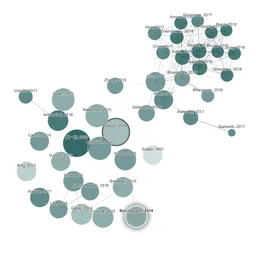
Creates interactive graphs of academic papers based on citation networks for easy exploration.
Suggests related papers that might be overlooked in traditional searches, based on semantic and citation analysis.
Analyzes citation counts and patterns to identify influential works and research impact over time.
Allows exporting graphs as images (PNG) or data files (CSV) for integration into reports or presentations.
Enables filtering of papers by parameters such as publication year, citation count, or relevance score.
Supports handling multiple seed papers to compare and contrast different literature sets efficiently.
Accelerates the process of surveying existing research by visualizing connections between papers, making it easier to identify key works and themes.
Helps discover papers that cite or are cited by a seed paper, expanding the research scope beyond initial searches.
Highlights areas with few connections in the graph, suggesting opportunities for new studies or under-explored topics.
Assists educators in creating visual aids for courses on academic research methods or specific subject areas.
Provides evidence of literature coverage and identifies key references to strengthen proposals with comprehensive background research.
Facilitates sharing of literature maps with team members, ensuring aligned understanding and efficient knowledge transfer.
Tracks how research topics evolve over time through citation networks, aiding in forecasting future directions.
Prioritizes papers based on centrality in the graph, enabling efficient reading of the most influential works.
Helps researchers stay updated with recent works in their field before attending or presenting at academic events.
Organizes and visualizes one's reading history and interests, supporting lifelong learning and academic development.
Sign in to leave a review
Arxiv-sanity is an innovative web platform that enhances the arXiv repository by integrating machine learning for personalized paper recommendations. Created by AI researcher Andrej Karpathy, it helps academics and researchers efficiently discover and manage scientific publications. The tool uses algorithms like TF-IDF and collaborative filtering to analyze user preferences and suggest relevant papers from arXiv's vast database. Key functionalities include a personal library for saving papers, advanced search with filters by date, category, and citations, trend visualization to track popular topics, and similarity search to find related works. It is particularly valuable in fast-paced fields such as artificial intelligence, computer science, and physics, enabling users to stay updated with the latest research without manual browsing. The interface is designed for ease of use, allowing quick access to abstracts, PDFs, and metadata. By automating paper discovery, Arxiv-sanity saves time and improves research productivity, making it an essential tool for students, professionals, and enthusiasts in the scientific community.
CiteSeerX is a free, open-access digital library and search engine specifically designed for scientific publications in the fields of computer and information science. Developed and maintained by the College of Information Sciences and Technology at Pennsylvania State University, it provides researchers, students, and academics with access to millions of documents, including research papers, theses, and technical reports. The platform leverages advanced algorithms for citation indexing, allowing users to track citation networks and analyze the impact of publications. It features full-text search capabilities, metadata extraction, document clustering, and author disambiguation tools. CiteSeerX aims to enhance the discoverability and accessibility of scientific knowledge, supporting literature reviews, bibliometric studies, and research trend analysis. Its user-friendly interface and comprehensive database make it an essential resource for the computer science community, promoting open science and collaborative research.
Elicit is an AI research assistant designed to help academics and students explore scholarly literature more efficiently. Built initially by Ought, it can search research databases, cluster and summarize papers, extract key information from PDFs, and help generate structured literature reviews. Instead of manually combing through endless search results, users can ask research questions and see relevant papers organized by outcomes, methods, and other attributes. Elicit does not replace careful reading or methodological judgment, but it significantly accelerates early-stage scoping, hypothesis generation, and evidence mapping, making it particularly valuable for thesis work, systematic reviews, and policy or product research projects that rely heavily on academic papers.